Monday, July 1, 2013

Parsons Garden: A New Look


What a week it has been! After kicking off with our first work party last Sunday and first pot luck on Monday (attended by over twenty-five people), the following days saw many additions to the garden. Two of the circle beds in Parsons were cleared out and expanded for... ASPARAGUS.
Asparagus

That's right. In just two to three years Williams will have its own asparagus forest. One reason asparagus had not been planted before is because it is a delayed perennial. It also requires trenches 6-8 inches deep for planting, which, given the amount of asparagus we planted, was a lot digging.

Then, on Thursday, our strawberries, blackberries and raspberries arrived. On Friday we began construction on our trellis, meant to serve both as a border, and new face for the garden. To do this, we imported black locust logs and forest managers from Hopkins Forest. In order to anchor the stakes we dug two foot post holes and surrounded the posts with crushed rock.
Construction on our berry trellis!
We then dug up the ground between them and transformed them into beds. Simultaneously, Lucy and a few garden interns from Mount Greylock High School, transformed a grown over bed into a strawberry patch. Now we must clear all of the dirt from the excavations and go back to the daily maintenance that is essential to all gardening.

Perhaps most importantly, our Facebook page (The Garden: Williams Sustainable Growers) is nearing 100 likes!!


Monday, June 24, 2013

First Work Party of the Summer!

Hello all!
The plants are enjoying all this sun after what seemed like gallons of drenching rain, though now we gardeners are experiencing the mild frustrations that come with watering time. One of our projects for the summer is restoring our drip irrigation system, as it is in an only semi-functional state. With a great new system at Mt. Greylock high school to look to, I think that we can make ours perform as we would like it to. And hopefully in the meantime the rains will return, as this is always a much easier way to keep the plants, and the gardeners, happy!
This past Sunday, Josh and I hosted our first community work party of the summer. We had seven intrepid volunteers venture out, even in the still-hot sun of late afternoon! Everyone was eager to help, and we were able to accomplish much more than Josh and I could ever manage by ourselves in an hour. This is especially true right now as I had a mountain biking accident last week that has left me with a banged-up, sore knee. I have been hobbling around as best I can, but most garden tasks are impossible for me right now, so it was great to have the help of our peers on Sunday. Josh has been wonderful about doing the work of both of us, but it's always helpful to have more hands (and legs) available! 

Our work party attendees helped us to wage war against the massive weeds that had overtaken the entire circle beds (see Alix with her spoils of war below) and to weed the overgrown garlic beds and cover them generously with straw mulch. The scapes are just starting to reach maturity, finishing their curly-Qs, and a number of us had a spicy taste-testing. We also pulled out the remaining chard plants from last season, giving us a nice view of the little babies that miraculously had sprung up underneath! All in all, it was a great gathering and I look forward to welcoming more new people to the garden as the summer continues!

Happy growing,
Lucy
P.S. If anyone reading this is on campus for the summer, come join us at our first community potluck! Monday night at 7pm in Currier Quad.

Wednesday, June 19, 2013

We're On It

Hello everyone,

This last week has been hectic and eventful. Our main goal has been to get all of the gardens to full production mode and we are most of the way there! This process entails clearing beds covered with weeds (and those ungodly oregano plants), broad forking the soil (which mixes and aerates it), adding compost and then raking the beds.

The weeds from the Presidential Garden 
Only then can the planting start. As of today, the presidential garden is completely planted. Four long rows of transplanted cucumbers, zucchinis, squash, watermelons, and melons sit beside a row of tomatoes. On the other side, this morning we planted seven short rows of carrots, radishes, arugula and cilantro. This is in addition to the potato plants and peas that were there before. Finally we planted a variety of beans between the peas and the fence. For now, the presidential garden is full! Down in parson's garden, we have planted both seeds and transplants. In addition to the potatoes, beets, garlic, basil, peppers, tomatoes, radishes, lettuce, kale, swiss chard (etc!), in the last few days we planted eggplant, more peppers, scallions, more beets, more basil, more lettuce, kale, parsnips, mustard greens, arugula, kohlrabi, carrots and bok choy. Even with all of these planted, a few rows are currently empty, waiting for the zucchini, brussels sprouts, peppers and okra currently sprouting in our grow cart. Up at Mount Greylock High School, we are still in the process of revamping some of the beds.
The Presidential Garden after a little work

However, we have planted beans are are on our way to perhaps planting another squash, zucchini patch. Lucy and I, (yes it is Josh writing, the mystery is solved) met with two of our high school interns (I am feeling pretty good about being an intern with interns) and they seem ready to get going. Back on the home front, we just placed an order for blackberry, raspberry, and strawberry plants, as well as asparagus crowns and rhubarb seeds. We are still looking for some grape vines. Williams growers, get ready for a new dimension to the garden: fruit!! Now, as the immediate planting gets completed we shall begin to look ahead to bigger plans that can be accomplished this summer. Stay tuned.

JMo

The Grow Cart keeping our transplants happy

A beet plant

Planting

A garlic scape almost ready to be harvested

Tuesday, June 11, 2013

Welcome to Summer

Hello garden followers!
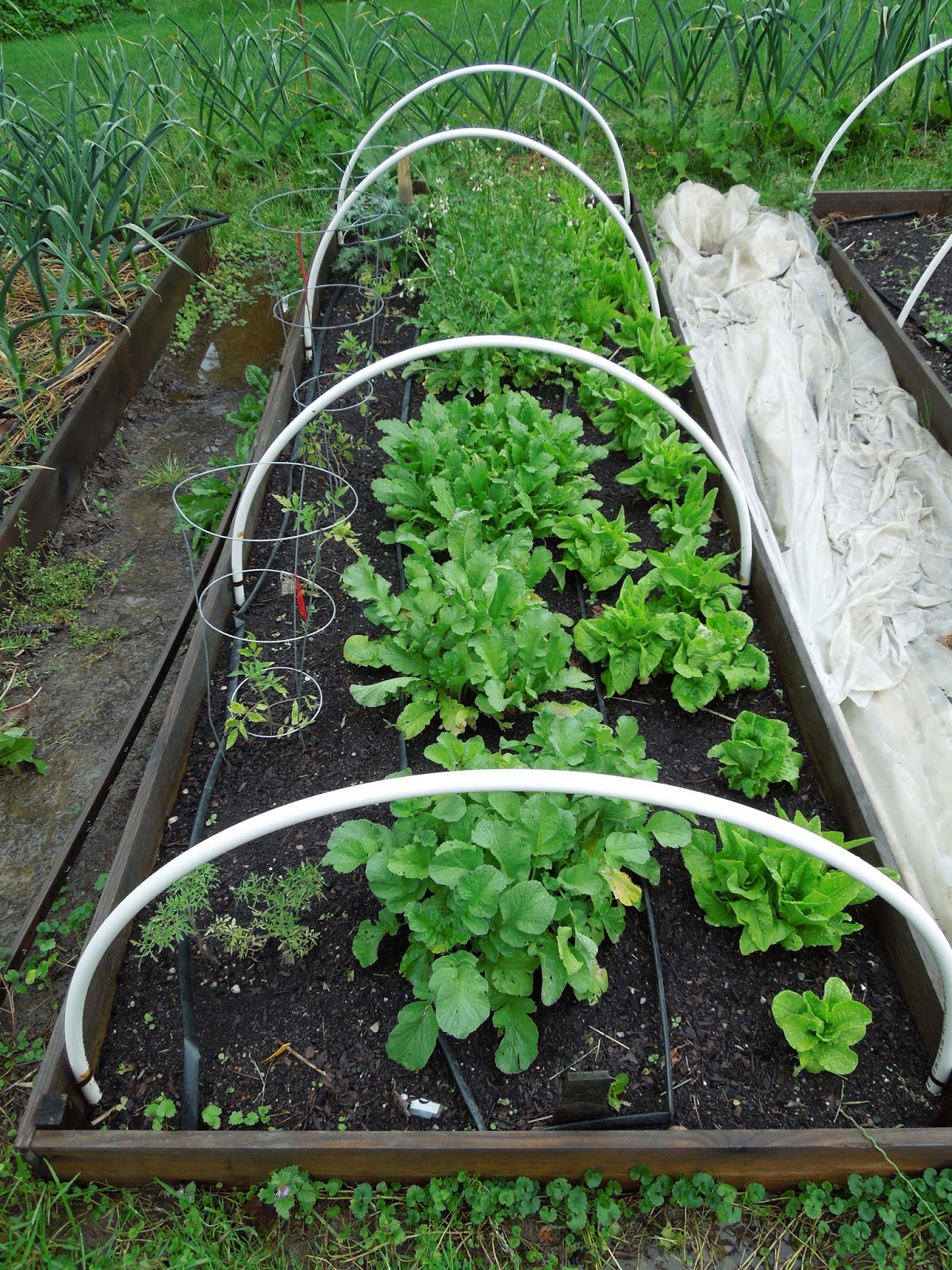
This is Lucy and Josh checking in, the garden managers for the summer. This is only our first day on the job, but we are already busy planning lots of projects to expand and improve the garden plots. There are many things growing in the gardens right now - garlic, wheat, potatoes, lettuce, tomatoes, peas - and plenty more to come. It has been very wet for the past few weeks so everything is a bit swamped right now, but it's nice not to have to water!
We are looking forward to pursuing a number of infrastructural projects this summer in addition to the vegetable-growing that we will be managing. Some of the possibilities that we are brainstorming right now are building trellises for berries and beans, cold frames for some of the raised beds, a hardy compost system, planting perennial crops such as strawberries or asparagus and evaluating and potentially updating our drip irrigation system. There are lots of options for what to do and we are excited to get to work!
In addition to taking care of the Williams gardens, we will be overseeing the student garden at Mt. Greylock High School along with four student apprentices. It will be great to be able to collaborate between the two schools and hopefully develop a connection that can continue throughout the school year.
Here are some photos of the garden right now:
Everything's looking very green!

Potato plants are thriving.

Lots of lettuce.

Swampland between the beds.

Peas taking over the trellis in the Presidential plot.

Josh is very excited about documenting the garden through photography, so expect many more photos to come!


Saturday, June 1, 2013

What’s that alternative media doing in this suburban house?!


This spring, the Williams Sustainable Growers published the third issue of our zine, Germination. This issue’s theme was ‘identity.’ It addressed topics of gender, sexuality, race, favorite foods, and future careers, among other things. And it included everything from poetry to doodling, surveys to various rambling, mixed-media articles. 

As the zine’s editor, of course I am partial to this particular type of publication, for the purpose of self expression alone. But I have to say that I think the theme of ‘identity’ is especially well suited to a zine. As a self-published, anti-consumerism media, I think it makes a space to really represent pieces of our identity on the printed page.

Almost by definition, zines have small print runs. They are often distributed through informal networks. I  gave a copy to my parents. When I came home from school last week, I found it--in its bright purple glory-- displayed next to the telephone. I couldn’t help but feel proud to see Germination and everything that I like to think it stands for (creativity, self-determination, food justice...) sitting there for all to encounter. 


Friday, March 15, 2013

The Great Garlic Giveaway of 2013

Garlic has been one of our best storage crops for the past two years: we plant in the fall and yield enough to save more for planting the next year as well as plenty for events like Garlic vs. Vampires and the occasional dinner. Garden produce is always available for anyone who volunteers at work parties, but this year we had enough left over that we decided to go public with our distributions. Lucky students who happened across the right corner of Baxter Hall last week went home with their very own head of super-local garlic!

Carrie Tribble '13 was kind enough to share a photo of what she and Zoe Grueskin '14 did with theirs:
"Whole wheat with roaster garlic loaf" ...looks yummy!

Monday, March 11, 2013

Seed Starting on a Sunny Sunday

After a long winter indoors, on Sunday, March 10 the Sustainable Growers began their spring season in beautiful 50 degree weather under cloudless skies. To prepare for the upcoming growing year, about fifteen students gathered outside of Dodd House to seed start vegetables for the grow-cart. We sat outside planting, talking, and enjoying each others' company in the warmth of the afternoon.


The Growers planted cold-hearty kale and broccoli to be transplanted in mid-April when the threat of frost still persists. In addition, we started later-season varieties such as tomatoes, peppers, and eggplants that require longer time to grow indoors. 


Although the garden is still covered in remnants of the last snow, the warm and dry Dodd Basement provides a great environment to nurture the seedlings. For the next two months, we will tend to the trays and most likely add more as the season progresses. Each day a member of the garden will water the plants, check on the grow lights, and prepare the vegetables for their transplantation into either the Parsons Garden beds or the Presidential Garden.


By 1:30, the group had planted hundreds of seeds. Proudly surveying the rows of future plants on the grow-cart, the Sustainable Growers looked forward to a bountiful season!

Saturday, December 22, 2012

Baking from the garden

Our garden veggies have leant themselves to many a lunch and dinner: stir fried, roasted, pickled...but all too often, dessert gets overlooked. (Though who could forget the garlic chocolate chip cookies?) But it was the end of the semester & the end of another wonderful season for the growers, and I wanted to do something special to make this gathering memorable. That's where the cake comes in.

Thanks to our hoop tunnels, the ground doesn't freeze. So we can leave beets in the ground and harvest at our leisure. Which is precisely what I did when I got it in my head to make red velvet cake dyed with beets! Surely, this would make the evening a celebration...and if the cake wasn't enough, well...the cream cheese frosting would be!

I researched. There are a lot of blogger/baker/amateur-scientists who have put their minds to the question already. The challenge, according to blogosphere, is to keep the cake acidic, so that the beet juice stays red, rather than browning in the oven.

In the end, our lack of good food processor led me to choose this recipe

this is the batter before we put it in the oven!


It was quite easy to follow. I used whole wheat flour, unrefined sugar, and I only had one cake pan so I couldn't layer it. Therefore, I only needed about half the frosting, so I mixed one 8 oz. package cream cheese with one stick of butter and added confectioner's sugar and vanilla to taste!

this is the cake out of the oven but still awaiting the frosting

Yum!


Sunday, November 4, 2012

Gleaning Adventure

While we're busy harvesting greens and prepping our beds for winter here on campus, farms in the area have been rushing to get their last summer vegetables harvested before it starts to snow. Ioka Valley Farm invited a team of volunteers to harvest their squash for donation to a local food pantry, a process of sharing the harvest known as "gleaning." Erik Romano '15 had a chance to check it out--here's what he has to report!


"On Sunday October 28th, I had the opportunity of going gleaning pumpkins, squash, and gourds near Ioka Valley Farm. For those who don't know what gleaning is, we basically harvested food that would otherwise go to waste (in this case, it goes to a local pig farm, because "pigs can literally eat anything" according to one of my fellow volunteers) and donated it to the Friendship Center, a food pantry in North Adams. It was a beautiful day, a bit chilly, but the weather was refreshing. There were hundreds of pumpkins, butternut squash and gourds on the field. We obviously couldn't harvest them all seeing as our group of volunteers consisted of around 10 individuals, me being the youngest by far. Unfortunately, a lot of squash was mushy due to the frost, but we picked what we could. We picked varieties including, butternut, delicata, acorn, sugarplum, and hubbard. I didn't know this before, but there are types of pumpkins bred to be jack-o-lanterns and ones bred for consuming, and the ones on the field were large jack-o-lantern-ready pumpkins. There were some smaller, darker orange pumpkins that were pie-ready as well, but fewer in quantity. I loved looking for the craziest alien gourds, which come in all shapes, colors, and sizes. Afterward, we stopped by a local school to give pumpkins for carving, and then drove the squash and gourds to the Friendship Center, who was happy to take them off our hands. I had an amazing time, especially since I was helping out those in need!"


Monday, October 15, 2012

Viking Funeral for Blighted Tomatoes

This past Saturday night we had a traditional Viking Funeral for our blighted tomatoes.  Why you might ask did we do this?  Blighted tomatoes must be disposed of properly, and although this what most farmer's might recommend, we felt that a good old celebration of our tomatoes in viking fashion might be the wacky kind of activity college gardeners could get excited about.  And they did!  We had a great turn out of 15 brave souls to wander through the darkness down Cole Field to the Hoosatonic River.

The tomatoes were lashed to a board, which was salvaged from the transfer facility, with rope from the garden shed.  Four pallbearers carried Thorn, our viking tomato king, down through the woods to the water's edge.  As the flames were prepared, a poem in Olde English was read and the mood turned somber.  Two volunteers donned waders, typical for fly-fishing, and entered the water with Thorn.  The board was lit, and the board was pushed out onto the still water.


As the flames drifted down into the darkness a second passage in Olde English was read.  We raised our glasses to honor Thorn, and the festivities finished.  It was a spontatneous celebration and memorial of our tomatoes.

Monday, September 24, 2012

Garden Dinner

Welcome back, gardeners!
After an incredible and bountiful end-of-summer harvest, the Williams Sustainable Gardeners, with the help of Dining Services, held the second annual Harvest Dinner. This year, the superb weather allowed for the dinner to take place in Parsons Garden. Much of the menu consisted of produce that was grown right in the garden where it was served!

The Harvest Dinner Menu:
Tossed Salad
Garlic Knots
Roasted Garden Squash
Pickles and Pickled Beets
Grilled Corn on the Cob
Baked Potato Bar with Goat Cheese and Chives
Apple Pie with Maple Yogurt
While much of the produce grown this summer has since been harvested, many greens, tomatoes, and herbs continue to grow. We will also be planting more greens and wheat in the near future. We also hope to expand our horizons and our learning by partnering with other groups on campus.
Coming next time... Taste the Rainbow! WSG and QSU unite! 

Thursday, August 16, 2012

A New Fence for the Garden

Deep in the heart of Williams campus, behind a wall and beside a large, white house, there lives a garden.  Few know of its existence and fewer still have ventured within.  This, the Presidential Garden, is one of the best kept secrets at Williams.  If you ask the average Williams student about the garden, they might raise their eyebrows and ask if you're on the right campus.  Sometimes I wonder if Adam Falk even realizes there is a garden in his yard.

At the beginning of the summer, the garden's low profile may have been fitting - it was unkempt and overgrown, with more weeds than vegetables in sight.  With a bit of clean up, however, it began to look quite respectable.  
The garden, post weeding extravaganza.
I decided then that the Presidential Garden deserved more attention than it had been getting.  So when Brent suggested that we build a new fence for the garden, I was easily convinced.  Ever since then, he and I have been dreaming and scheming about every kind of fence imaginable.  Images of bamboo fences, classic white picket fences, fences made of bricks, stone, and wrought iron - all of these have crossed my mind.   

As we planned the fence, Brent and I had to keep a few specifications in mind.  Originally built to keep out hungry bunnies, the fence had to be practical; this meant chicken wire buried about a foot underground.  And because of its snazzy location next the the Presidential abode, it had to be aesthetically pleasing.  It also needed to be as permanent as possible, so that it could be enjoyed by generations of Williams gardeners to come.  So when Drew Jones of Hopkins Forest offered us a large supply of old split rails made of black locust, we knew we were in luck.  Not only would the rails fulfill all of our requirements, they were free.  And they would lend a much-needed rustic edge to the perfection of the President's yard.  We decided that the fence would consist of wire fencing stretched between the sturdy rails, with a gate made of salvaged boards and chicken wire. We set the ambitious goal of finishing the project, including the gate that went with it, in a single day.

Construction of the fence began early one warm day in July.   With the help of post hole-diggers, rock bars, and student workers from Hopkins Forest, we dug over 20 two-foot-deep holes into the rocky soil of the Presidential yard.  Raising the tall rails into the holes, we set them straight and packed the soil tightly around them.  

Once all the rails were in place, we unrolled a large bundle of wire fencing, stretching it taut and nailing it tightly between each post.  (We were disappointed to find that our 50 ft roll was several feet too small to fit the perimeter, a problem we fixed later by patching the gap with chicken wire).  We repeated this process with a smaller roll of chicken wire, lowering it into a trench we had dug and burying it in the soil to deter garden pests.  At the same time, we added a layer of black weed barrier, hoping to keep weeds from entering the garden from the outside.  

The final challenge was constructing a gate for the garden that would fit snugly and swing freely.  We fit the salvaged boards carefully to the shape of the gap we left in the fence, screwing them in place.  Next, we screened the frame with chicken wire.  The trickiest part was screwing the hinges into the gate and then into the rails, taking care to keep the gate at the appropriate angle above the ground.  With a few minor adjustments, the gate was in place!  It was incredibly satisfying to open the gate for the first time, it swinging smoothly to let me into the garden.  Voila! A new fence for the garden.

A watermelon in the President's yard.

Now, the Presidential Garden overflowing with ripe corn, winter squash, watermelons, cantaloupes, and beans!  Complete with painted vegetable signs, I'd say its quite deserving of its new defenses.  So if you're ever in the neighborhood of the Falks, you should stop on by.


Tuesday, August 14, 2012

Thoughts on the Summer

Here's a link to a reflection I wrote about my time in the garden this year.  Enjoy!

http://sustainability.williams.edu/sustainable-food/grow

(E)scape!


Hi, everyone!  I’m sorry it’s taken me so long to post.  Things have been pretty busy around here.  However, just because I didn’t post doesn’t mean there wasn’t anything to blog about!  The last couple of months have been filled with exciting projects and even more exciting produce.

For instance, at the end of June, the Garden held an (E)scape party – a party for pickling scapes!  At the same time, we made pesto from the vast quantities of arugula we harvested and the garlic leftover from last year.  I’ve posted both recipes below, in case you ever find yourself overwhelmed by either of these vegetables. 
Brent and Cedar with garlic from the garden

The canning apparatus (to the right)
I’ve never canned before, so I was thrilled to get the opportunity to try my hand at it, under the knowledgeable guidance of Brent.  The whole process is pretty extensive, but it’s a wonderful way to make sure you’re eating your own vegetables all year round!  The procuedure breaks down into several distinct steps: washing, chopping, preparing the brine, blanching, filling, and sealing.
Washing the scapes

The biggest concern with canning at home is preventing growth of the bacterium Clostridium botulinum from occurring after you’ve sealed your jars shut.  C. botulinum is a nasty little bug that .  It colonizes the gut, leading to respiratory and musculoskeletal paralysis.  That's why it's so important to start with very, very clean mason jars (we washed ours thoroughly before using them).
Clean mason jars

Blanching in brine
Fortunately, the bug can be destroyed by boiling for a few minutes and by keeping the pH of your brine within a certain range.  Blanching the scapes for a minute takes care of both of these steps, cooking the bacteria and ensuring an even pH both inside and outside the vegetable; thus, blanching is a key step in the canning process. 

The scapes, in all their glory
After blanching the scapes in our brine, we packed them as tightly as possible into mason jars.  Then, we filled the remaining space in the jars with brine, knocking out all the air bubbles we could find. 

Finally, we closed the jars by placing them in boiling water until a seal was created  under the lids.  

Voila – pickled scapes!  


Garlic Scapes
Pickling brine and process instructions

Brine ingredients:
4                cups                           apple cider vinegar
3                cups                           water
1½            cups                           sugar
3                Tablespoons            kosher salt
as needed                                    spices

Procedure:
1)     Wash and cut garlic scapes into jar-length segments, keeping the straight pieces and curved pieces separate.
2)     Pre-heat the jars and lids.
3)     Mix brine ingredients and bring to a boil. Add spices to brine, if desired.
4)     Test the brine pH (should be ≤ 3.9).
5)     Blanch the scapes in the brine: boil one minute.
6)     Remove the scapes and strain the spices out of the brine, if used.
7)     Pack the scapes into clean warm jars. Curl the curved portions on the outer part of the jar, and put the straight portions in the center of the jar.
8)     Top off the jars within 1/2” of the top with hot brine.
9)     Seal the jars finger tight.
10)   Process the jars in a boiling water canner: quarts for 15 minutes, and pints for 10 minutes.
11)    Allow the jars to cool before handling.
12)    Test the equilibrium pH; it should be ≤ 3.9.

Sunday, June 17, 2012

Orange, and Yellow and Red, Oh My!

This is just a quick post to share the huge variety of carrots that are growing in Williams garden!  There are have several strains growing within a single bed in Parson's: Minicor, Cosmic Purple, Scarlet Nantes,Yello, and Nelson.  The Cosmic Purple, deep crimson with a bright orange interior is my favorite carrot, and quite a bold vegetable indeed.  It seems to grow to a much more imposing size than do the other varieties.

The bed wasn't thinned properly, so we also got some pretty interesting carrot shapes!

The orange one in the middle looks like a squid.


This evening, I used garden carrots to make a lovely carrot, snap pea, avocado, and cilantro salad.  Quite refreshing!  I think the different varieties of carrots are beautiful together.  From now on, I plan to be permanently dissatisfied with plain ol' orange carrots from Stop and Shop.

Who knew carrots took so many different forms?

Wednesday, June 13, 2012

Bunnies, bunnies, everywhere!

I was pretty reluctant to post a story about this, because I think it might be the most interesting thing that happens in the garden this summer.  However, I decided that it was too exciting not to share!  Just promise that you'll keep on reading.

I was watering the greens the other day when, lo' and behold, the earth started to move under the chard!  I leaned closer to take a look.  Pushing aside a giant leaf, I realized that what I thought was dirt was actually a sizeable hole in the ground, convincingly camouflaged with fur and dead leaves.  And what did I find sticking out of the hole, but several tiny bunny ears and tiny bunny noses!  As I observed, the patch of ground started to wiggle and more bunny limbs came poking out of the hole.  Rabbits were living - where else? - in the cabbage patch! (Technically, the bed only contained one row of cabbage, but the cliche of rabbits in a cabbage patch is just too hard to resist.)  

Unexpected visitors (or am I the visitor?)

The bunnies were very hard to see at first, but I eventually counted 5 of the little guys huddled together.  They didn't seem very happy to have been watered, but didn't look like they would be moving any time soon.  Which left me with a dilemma: rabbits aren't known for their gardening skills.  In fact, they're pretty terrible at gardening.  Quickly dispelling dreams of a private garden workforce of pet rabbits, I realized the bunnies wouldn't be any help at all - and might even *gasp* eat the plants!  It was even pointed out to me that rabbits can reproduce in 3 months, yielding an exponentially increasing army of bunnies that would take over the garden and, eventually, the entire Williams campus.  Something had to be done.  

One of the cutest things I have ever seen.
I decided that the bunnies needed to be relocated elsewhere.  However, I still wasn't sure how to move them.  Thankfully, my friend Anna had an idea.  We would put the bunnies in the box!  This method seemed pretty ideal, until the bunnies realized that we were after them.  After we picked up the first one, a couple stayed in the nest, but the rest of them started hopping away!

A rogue bunny!
Luckily, baby bunnies aren't great at hopping and didn't venture outside of the bed of greens which they liked to call home.  It wasn't too much trouble to track them down and scoop them up, one at a time.

After a few minutes of rabbit-wrangling, we had them all trapped safely in their box.  Catching the bunnies was both wonderful (they were so soft!) and horrible (they were pretty unhappy) at the same time.  Most of them tried to jump out of the box.  Somehow, they didn't seem comforted by the bok choy and chard with which we covered them.

A boxful of bunnies
After arguing over which part of the bunnies was the cutest (their miniature paws or their tufty tails?  Or their little twitchy noses???) Anna and I did some internet research about how to relocate families of rabbits.  We soon determined that they were likely old enough to live on their own, and picked up some interesting facts along the way (ex. Did you know that mother bunnies must lick their young offsprings' genitals to help them pee? Whouldathunkit.)

Box in arm, we set off across campus to find a new home for the bunnies.  After scouting out a decent spot in the drizzly weather, we released them into an overgrown, wooded area far, far away from the garden.

As we watched them scamper off into the underbrush, we wished them a safe and happy life eating someone else's vegetables.